The Introduction: Why We Stumble When the Camera Starts Rolling
You’ve practiced your script, you’ve mastered your content, and you’ve visualized success. But the moment that red recording light flickers to life, something breaks. You feel your skin go pale, cold sweats prickle your forehead, and your mind—previously a vault of brilliant ideas—goes completely blank. This isn’t a lack of talent; it is “Red Light Syndrome” (RLS). As defined by Urban Dictionary, RLS is a phenomenon where a person possesses genuine musical or performance talent but “falls to pieces” the moment they are being recorded. It is a biological ambush. Being watched triggers scopophobia—the primal fear of being scrutinized—which activates your fight-or-flight response. Your brain interprets that glass lens as a predator, causing your voice to quiver and your palms to sweat. This “freeze” happens to the best of us, from beginner YouTubers to superstars like Cynthia Erivo. The pressure of permanence—the idea that every stumble will be preserved forever—creates a massive gap between your “true self” and the “idealized self” you feel forced to project. As a performance coach, I’m telling you that you must bridge this gap. You don’t need to be a “natural”; you need a high-impact strategy to hack your biology and reclaim your presence.
1. Stop Performing and Start Talking to One Person
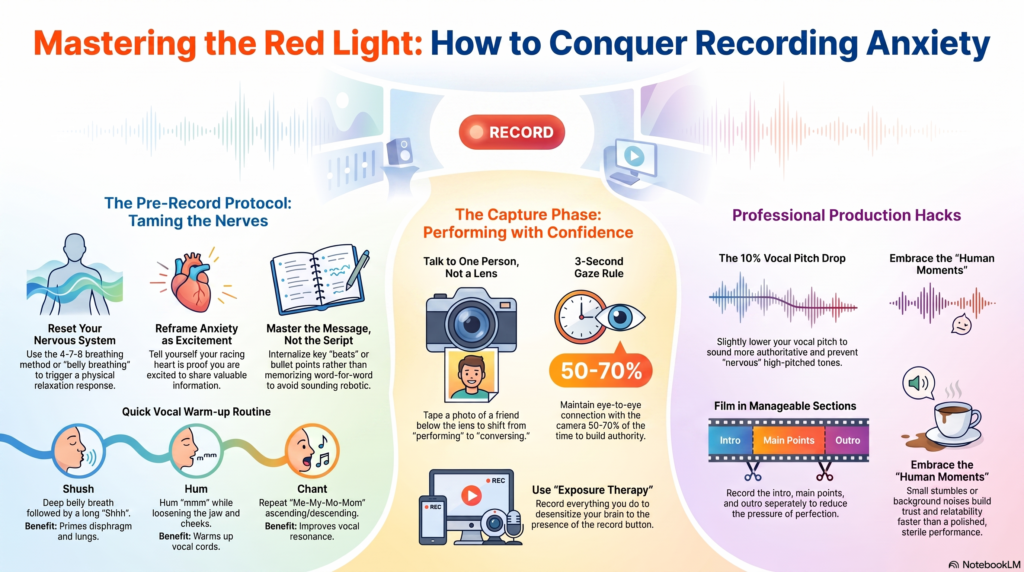
The biggest mistake you can make is trying to speak to an “audience” or a “subscriber count.” When you speak to a crowd, you connect with no one. To fix this, you must execute a “Mental Shift”: stop performing for a camera and start having a conversation with one specific person. Identify a friend, a past client, or a family member who genuinely needs your message. Imagine they are sitting directly across from you, leaning in to hear what you have to say. Pro-Tip: To anchor this mindset, tape a physical photo of that person, or even a pair of “googly eyes,” right next to the camera lens. This gives your brain a focal point for human connection rather than a cold piece of tech.”That mental shift turns ‘performing for a camera’ into ‘talking to a friend,’ and the difference is immediately visible. Your face relaxes, your voice sounds natural, and your personality actually comes through.” — Chris Peter. By shifting from a one-way performance to a two-way dialogue, you naturally lower the stakes and allow your true personality to emerge.
2. The “Always-On” Strategy: Use Exposure Therapy to Banish Nerves
You cannot think your way out of recording anxiety; you must record your way out. Motion designers and DJs often struggle with the transition from their “final product” (the art or the mix) to the “vulnerability” of being a talking head. The solution is Exposure Therapy—desensitizing your nervous system through bite-sized repetitions.The methodology is simple: Hit record every time you practice. Even if you plan to delete the footage immediately, the act of seeing that red light must become as mundane as checking your email.When you are ready for a real session, follow the 3-Take Rule :
- Take 1: The “Stiff” Take. You are warming up. Accept that it will be awkward.
- Takes 3 and 4: The “Sweet Spot.” You are warmed up but still fresh. This is usually your best work.
- The Final Take: The “Overthought” Take. If you keep going, you will become fatigued and sound like a robot. Stop before you hit this wall.
3. Embrace the Mess: Why Your Mistakes Are Actually “Features”
Perfectionism is the fuel of Red Light Syndrome. To overcome it, you must understand a clinical concept known as Processing Biases. When we are anxious, we selectively search for behaviors we interpret negatively, ignoring the 90% of the performance that was excellent. Stop searching for flaws and start embracing the mess. In the world of professional DJing, a mix engineer doesn’t scrap a two-hour set because of one bad transition; they create a “composite” by re-recording that segment and stitching it back in later. Use the Pause and Reset technique: When you stumble, do not stop the recording. Simply pause, take a deep breath to reset your Vagus nerve, and say the line again.”Mistakes give everyone permission to be human and make the video message more engaging.” — Atlassian. Relatability builds trust. When you allow your audience to see a human moment, you give them permission to connect with you.
4. Hack Your Biology: The Vagus Nerve Reset
Anxiety is a physical state, but so is confidence. In the 60 seconds before you hit record, you must shift your body from “anxiety” to a state of “rest” or “excitement” by stimulating the Vagus nerve.Vocal Toolkit:
- Humming: Loosen your jaw and vibrate your lips to warm the vocal cords.
- Tongue Trills: Flutter your tongue through ascending and descending pitches.
- The “Meme-Mime-Mome-Moom” Chant: Repeat this to develop resonance and clear away vocal raspiness.
- The “Ma-Pa-Ta” Drill: Rapidly repeat these syllables to sharpen your enunciation and ensure your mouth is ready for clear delivery.Biology Hacks:
- Box Breathing: Inhale for 4 counts, hold for 4, exhale for 4, hold for 4.
- The Power Posture: Position matters. Lean forward into the camera lens. Leaning back signals retreat and anxiety to your brain; leaning forward puts you in an “offensive” (confident) position.
5. The Mirror Perception and the Power of Eye Contact
Self-consciousness is often triggered by the “Mirror Image” default. Human beings find their own faces asymmetrical and jarring when they aren’t mirrored because we are accustomed to seeing our reflection. If your software allows it, keep the “flipped” view while recording to feel more comfortable, but ensure the final output is un-flipped for the viewer.Technical Setup for Authority:
- The Eye-Line Rule: Position your camera at eye level (use a stack of books if necessary). Looking up undermines your authority; looking down feels dismissive.
- FaceTime Distance: Position the lens slightly closer than feels comfortable—roughly the distance of a FaceTime call—to simulate intimacy.
- The Three-Second Gaze: To build rapport, you must maintain a direct gaze for 30% to 70% of the time. Hold your gaze on the lens for three seconds at a time to establish a steady, trustworthy connection.
- Downward Pitch: End your statements with a downward vocal pitch. Ending on an upward pitch sounds like you are asking for permission; a downward pitch sounds like a statement of fact.
The Conclusion: Reframing Anxiety as Passion
Red Light Syndrome is not a sign that you are failing; it is a symptom of the fact that you care about your craft. The camera is not a predator waiting for you to stumble; it is a tool designed to show the world exactly who you are. The goal isn’t a flawless performance—it’s a human one. If you knew that your audience was rooting for your humanity rather than your perfection, how differently would you hit record today?
Click Here to Check out our Free Guide – Camera Confidence After 40